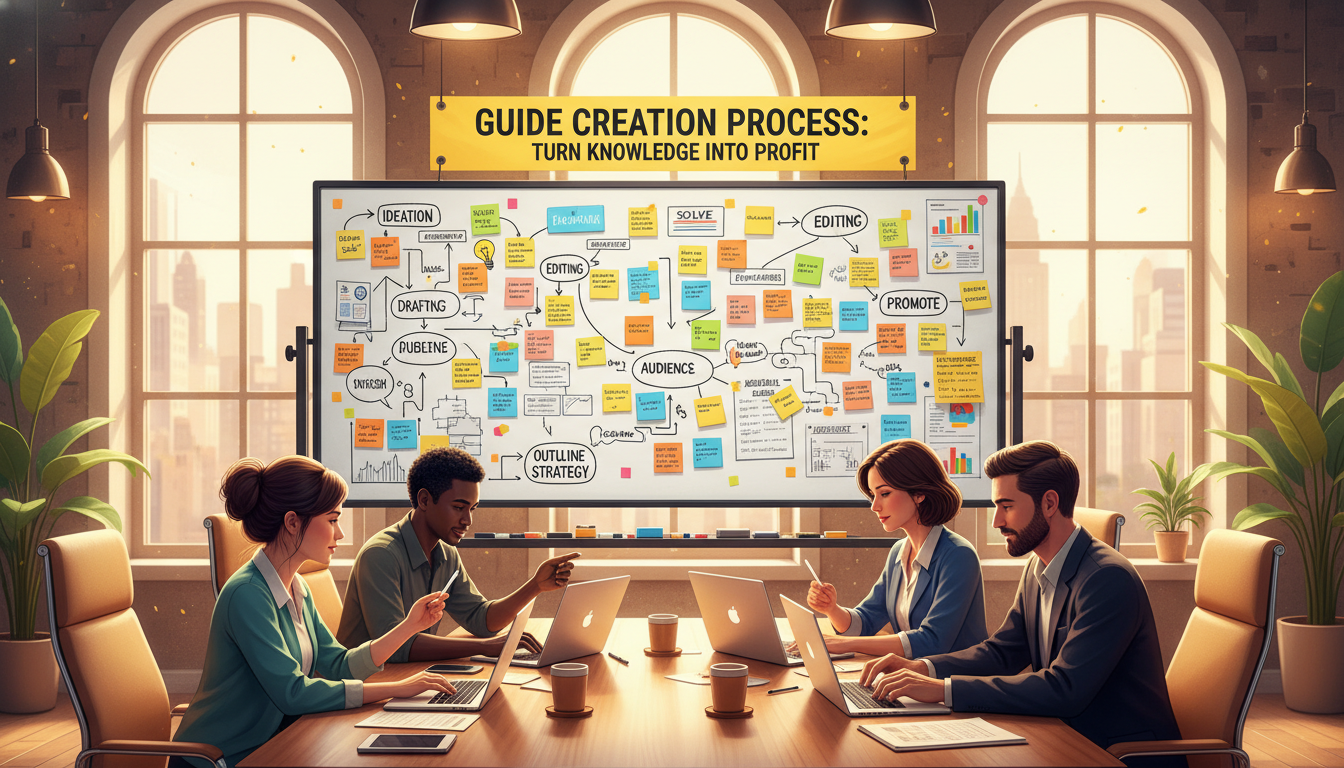
Sharing your expertise can build a steady income. Many people are looking for clear, actionable information. By packaging your knowledge into a structured guide, you can address a real need in the market.
There is a significant demand for instructional content. People constantly seek solutions and new skills. A well-crafted guide can establish your authority and attract a dedicated audience. The digital format offers incredible flexibility and the potential for a scalable business.
The journey from a simple idea to a finished, income-generating product is a clear process. It involves planning your core content, structuring it effectively, and choosing the right platform for distribution. This approach has a low barrier to entry, allowing anyone with valuable knowledge to get started.
Many have built successful, sustainable businesses by sharing their knowledge. This guide will walk you through the essential steps to turn your know-how into a reliable source of revenue.
Key Takeaways
- Sharing expertise through structured guides can generate a consistent income.
- There is a high demand for clear, actionable instructional content.
- Digital products like guides are flexible and can be scaled effectively.
- The process is accessible, with a low barrier to entry for creators.
- Building a focused audience is key to your content’s success.
- Strategic marketing and the right platform choice are crucial for visibility.
Introduction: Turning Your Knowledge into Income
Imagine packaging your unique skills into a product that solves real problems for a specific audience. This is the core of turning what you know into a sustainable revenue stream. The digital world has erased the old barriers between experts and those who need their guidance.
For a long time, specialized knowledge was often guarded. Today, a significant paradigm shift is happening. Sharing expertise for profit is not just accepted; it’s a respected path to build a business from your know-how.
This requires a psychological shift. You must start seeing your expertise as a legitimate, sellable asset. The hesitation many feel—questioning if their knowledge is “good enough”—is the first barrier to overcome.
Data shows a surge in professionals building full-time incomes by packaging their know-how. The creator economy and growing demand for self-education are powerful forces. People are actively seeking knowledge to improve their lives and skills.
Remember, people don’t just buy information. They are buying a specific transformation. Your guide’s value isn’t in the pages of text, but in the new outcome it provides for the customer.
Consider a real journey: a simple blog, focused on solving a specific problem, can grow into a substantial business. The author’s own path from a simple site to a million-dollar business with online courses proves this. The key was shifting from sharing information to serving a specific audience’s needs.
Your success hinges on solving a specific, painful problem for a well-defined group. This focus moves you from a generalist to a trusted authority.
The right mindset is crucial. This work is about service, authenticity, and a relentless focus on delivering results. It’s about building trust and providing genuine value.
This guide will walk you through the process. We’ll cover finding your niche, creating high-value content, and building a system that connects your knowledge with the people who need it most.
Why How-To Guides Are a Powerful Way to Make Money
Transforming your specialized knowledge into a structured guide offers a scalable path to building significant, automated revenue. This model leverages your existing expertise into a digital asset that works for you continuously.
The market demand for specialized, actionable information has never been higher. The global e-learning market is surging, driven by a widespread shift toward self-education and the growth of the gig economy. People are actively seeking curated, step-by-step solutions to specific problems, from mastering software to launching a side business.
Digital products like guides have a powerful economic advantage: near-zero overhead and infinite scalability. Unlike a physical product, the cost of creating one more copy of your digital guide is virtually zero. This model allows for incredible scalability; the same product can be sold to one person or one hundred thousand without extra production costs.
This leads to the powerful concept of passive income. You create the guide once, and it can generate revenue for years with minimal ongoing effort. It becomes an asset that earns while you focus on other projects or create more content. This “create once, sell forever” model is a cornerstone of building digital assets.
Psychologically, people don’t just pay for information; they pay for convenience and a clear, trusted path to a desired outcome. They are not buying a course; they are buying a specific result. A well-structured guide offers curated, actionable steps that save the customer time and frustration, providing immense perceived value.
Compared to other common creator income streams, a guide offers unique control and ownership. Unlike affiliate marketing, you own the customer relationship and keep 100% of the profit after platform fees. Unlike ad-based revenue, your income isn’t tied to volatile traffic or platform algorithms.
The following table highlights how a guide business compares to other popular creator models:
| Model | Control Over Income | Scalability | Passive Potential | Barrier to Entry |
|---|---|---|---|---|
| How-To Guide Business | Full control over product, pricing, and sales. | Highly scalable; one product can be sold indefinitely. | Very High. Create once, sell repeatedly. | Low. Requires expertise and effort to create the asset. |
| Affiliate Marketing | Low. Reliant on third-party products and programs. | Scalable, but commissions are a small percentage. | Moderate. Requires consistent traffic generation. | Low. Easy to start, but highly competitive. |
| Display Ad Revenue | Very Low. Reliant on platform and traffic. | Limited by traffic volume and ad rates. | Low. Requires constant traffic flow. | Low to Moderate. Needs significant traffic. |
| Freelancing / Consulting | High control, but tied to your time. | Not scalable. Income is limited by hours worked. | None. Income stops when you do. | High. Requires proven expertise and finding clients. |
Ultimately, the power of a guide lies in its efficiency. It packages your knowledge into a system that solves a specific problem for a specific audience. This creates a direct, valuable transaction where you are paid for the transformation you provide, not just your time.
How to Make Money by Creating How-To Guides
The first step in monetizing your skills is to conduct a thorough self-audit of your knowledge and experience. This practical process has two pillars: first, identifying and packaging your unique expertise, and second, rigorously validating that there is a market eager to pay for your specific knowledge.
Leveraging Your Expertise
Your journey begins with a clear self-assessment. What problems do you solve consistently for yourself or others? Your unique expertise, gained from years of work, a unique hobby, or a specific skill, is your most valuable asset. An honest audit of your skills and experiences is the first step to building a profitable guide.
Consider the diverse ways experts monetize their knowledge. Many writers, for example, don’t just write—they teach, consult, and create digital products from the same core knowledge. The principle is to see your expertise as a product suite. The key psychological principle here is that people don’t buy information; they buy outcomes. They don’t want a course on social media; they want more customers. Your guide must promise and deliver a clear, desired result.
Start by listing your skills, experiences, and successes. Then, identify which of these can be broken down into a teachable, step-by-step process. This is the foundation of a valuable guide.
Understanding the Market Demand
Your passion must meet a market need. The most brilliant guide on a topic no one searches for will not sell. Validation is non-negotiable. This is where the second pillar comes in: market demand.
Start by validating your guide idea. Use free tools like Google Trends, AnswerThePublic, or Ubersuggest to gauge search volume and related questions people are asking. Look for a “sweet spot”: a topic with decent search volume but not so much competition that you can’t be seen.
For example, a dietitian might notice a common, specific question from new parents: “How much food should my baby eat?” This specific, high-intent question led one professional to create a best-selling guide on baby portion sizes. This is the perfect intersection of expertise and proven demand.
The following table illustrates how to align your personal knowledge with what the market wants, helping you find a profitable niche.
| Your Expertise (You Have This) | Market Demand (They Need This) | Profitable Niche (The Intersection) |
|---|---|---|
| Advanced knowledge of organic gardening | People want to grow food in small urban spaces. | A guide to “Balcony & Small-Space Organic Gardening.” |
| Expertise in personal finance for freelancers | Freelancers struggle with irregular income and taxes. | A course on “Financial Systems for Freelancers and Solopreneurs.” |
| Experience building a following on a specific social media platform. | Small business owners need a clear strategy for that platform. | A step-by-step guide to building a local customer base on that platform. |
Your goal is to find the overlap between what you know deeply and what a specific group of people will pay to learn. This validation step separates a hobby project from a profitable digital product. Use this research to refine your guide’s topic, ensuring there’s a ready audience actively seeking the content you can provide.
Finding Your Profitable Niche
A profitable niche is found where your specific knowledge meets a clear, urgent need in the market. It’s the sweet spot between what you know and what a specific group of people are actively searching for and will pay to solve. This section will walk you through identifying that perfect intersection.
Identifying Your Audience’s Pain Points
Your first step is to listen to your potential customers. What specific problems keep them up at night? Go where they gather online to understand their challenges.
Effective methods for this research include:
- Social Listening: Monitor forums like Reddit, niche-specific Facebook groups, and Q&A sites like Quora. Look for recurring questions and complaints.
- Community Engagement: Join online communities and forums where your audience spends time. Pay attention to the language they use to describe their struggles.
- Direct Outreach: Surveys, polls, and even direct messages can reveal the exact language your audience uses to describe their problems.
For example, the dietitian who created a successful guide on baby portion sizes didn’t guess at the need. She listened to new parents in online parenting groups, identified their specific anxieties about feeding, and created the exact content they were seeking.

Analyzing the Competition
Before you build, you must understand the landscape. Research other guides, courses, and resources in your potential niche. Your goal isn’t to copy, but to find your unique angle.
Look for gaps in what competitors offer. Are their guides too basic? Too expensive? Lacking in actionable steps? Your competitive analysis should answer these questions.
| Competitor Feature | Their Offering | Your Unique Angle |
|---|---|---|
| Content Depth | Offers surface-level tips. | Your guide provides step-by-step systems. |
| Format & Delivery | Only a PDF download. | PDF + video walkthroughs + a private community. |
| Price Point | Premium one-time fee. | Competitive introductory pricing or a payment plan. |
| Target Customer | Beginners only. | Tailored for beginners AND intermediate users. |
This analysis helps you position your guide not as “just another” product, but as the clear, superior choice for a specific audience.
Validating Your Guide Idea
Before spending months creating a product, test the market. Validation turns a good idea into a solid business plan.
Use these strategies to gauge real interest:
- Pre-Selling: The strongest validation is a pre-sale. Create a simple landing page describing your guide and collect email addresses or even pre-orders.
- Minimum Viable Product (MVP): Offer a core module or a detailed outline to a small group for feedback before building the full course.
- Build an Email List: Create a simple website or landing page offering a free, valuable resource (like a related checklist or a sample chapter) in exchange for an email address. The sign-up rate shows interest.
This validation step, as discussed by experts, separates a hobby project from a viable business. By confirming that people are willing to invest before you’ve built the entire product, you de-risk your effort and ensure you’re creating something your audience truly wants.
Planning and Structuring Your Ultimate Guide
A powerful guide is not written; it is engineered. The difference between a forgettable document and a transformative resource lies in meticulous planning and a learner-focused structure. This phase is the architectural blueprint, determining whether your content guides a user to success or leaves them confused.
Before you write a single word, you must have a crystal-clear vision of the destination. This foundational work prevents a scattered, ineffective guide and ensures every element serves the learner’s journey from start to finish.
Defining Learning Outcomes
Start with the end in mind. What specific, measurable change will your customer experience? A clear learning outcome moves beyond “learning about a topic” to “being able to perform a specific task.”
Use the Post-it note method from our source. Write every discrete skill or piece of knowledge your learner needs on individual sticky notes. The goal is to define the final transformation. For instance, the outcome isn’t “understand social media,” but “create a month’s worth of engaging posts for a specific platform.”
This reverse-engineering is crucial. Ask: “What will the learner DO differently after finishing my guide?” Your answer defines your learning outcomes. This clarity becomes your North Star, ensuring every chapter, section, and step in your blueprint has a purpose.
Creating a Step-by-Step Blueprint
With the destination set, you map the journey. Break the complex skill into logical, sequential steps. This is where the Post-it notes are arranged into a flow. Group related concepts into modules, ensuring each one builds on the last.
A modular structure is key. It enhances the learner’s experience by preventing overwhelm and allows for future updates. This modularity also creates upselling opportunities; a basic guide can lead to an advanced module.
The structure should feel like a guided tour, not a maze. Each step should have a single, clear objective that builds toward the larger outcome.
| Learning Outcome (The Goal) | Module / Step in Blueprint | Key Activity |
|---|---|---|
| Learner can set up a professional blog. | 1. Platform & Hosting Setup | Research and select a hosting provider; install a CMS. |
| Learner can write SEO-optimized articles. | 2. Content Creation Framework | Conduct keyword research and apply on-page SEO structure. |
| Learner can design a basic content calendar. | 3. Content Planning | Brainstorm post ideas and map them to a quarterly calendar. |
| Learner can analyze basic traffic data. | 4. Analytics & Adjustment | Set up Google Analytics and interpret key metrics. |
The table above illustrates how learning outcomes directly map to specific, actionable steps. This clarity is the blueprint for your guide. It also reveals where learners might need extra resources, like a worksheet or a video tutorial, which can be linked or sold as a premium add-on.
This structured, modular approach ensures your guide is a clear path to success, not just a collection of information. It’s the difference between giving someone a pile of bricks and giving them a blueprint for a house.
Choosing the Right Format for Your Guide
Your guide’s format is its final, tangible form. It’s the final, tangible package that delivers your knowledge. The format you select has a direct impact on the user experience, the perceived value, and ultimately, the customer experience. The best format aligns with your content and the way your audience prefers to learn. A software tutorial might need a video, while a complex planning guide may work best as an interactive workbook.
Consider your topic’s complexity and your audience’s preferences. A blog post might link to a simple PDF, but a complex software course demands video. The right format makes your content more accessible and effective. It’s the final, crucial step in the process of packaging your expertise.
This decision isn’t permanent. You can start with a simple PDF and later add video content. The key is to start with a clear vision. Your guide’s format should serve the customer journey, making the learning process smooth and effective.
E-books and PDFs
The classic, accessible, and versatile format is the written guide, typically delivered as a PDF or e-book. This format is ideal for step-by-step tutorials, in-depth reference manuals, or text-heavy content. Its major benefits are accessibility and a low barrier to entry. Your audience can read it on any device, at their own pace.
Creating a professional PDF is easier than ever. Tools like Canva or Adobe InDesign offer templates, but you can create a clean, professional guide using just Google Docs or a word processor. The key is a clean, readable layout with clear headings and images. For a more visual product, make sure to use a tool like Canva to design a compelling cover and internal graphics.
The major work here is in the writing and layout, not in complex production. You can update the PDF easily and resell the updated version. For many creators, a well-structured, actionable PDF is the perfect first product.
Video Tutorials and Screencasts
For content that is visual, sequential, or software-based, video is king. A video tutorial or screencast can show people exactly what to do, which is invaluable for software tutorials, crafts, or physical demonstrations. It builds a stronger connection as the audience can see and hear your instructions.
You don’t need a professional studio. A good microphone, a screen recording tool like Loom or OBS, and basic video editing software can produce high-quality results. The key is clear audio and a logical, well-paced demonstration. This format is powerful for complex step-by-step processes where seeing the work in action is essential for success.
Interactive Worksheets & Templates
This format turns passive information into an active workbook. Instead of just reading, your customer actively participates. This format is perfect for planners, budget trackers, business plans, or fitness logs.
You can create fillable PDFs with tools like Adobe Acrobat or online form builders. This format provides immense value because it helps the user make progress. For example, a financial planning guide could include fillable budgeting sheets. This product is not just information; it’s a tool for success. It encourages the user to apply the guide’s lessons directly, increasing its perceived value and effectiveness.
Here’s a quick comparison to help you decide:
| Format | Best For | Creator Effort | Ideal Audience |
|---|---|---|---|
| E-book / PDF | Text-heavy, reference, in-depth guides. | Low to Medium (Writing, Design) | Readers, researchers, those who prefer self-paced study. |
| Video Tutorial | Visual, software, or physical task tutorials. | Medium to High (Filming, Editing) | Visual learners, beginners needing a visual guide. |
| Interactive Worksheets | Planners, trackers, actionable exercises. | Medium (Design, Interactivity) | Hands-on learners, people who need structure. |
Your guide’s success depends on this choice. A video for a complex software course is more effective than a text document. A detailed checklist might be better as a downloadable, printable PDF. Choose the vessel that best carries your content to your audience.
Creating High-Value, Actionable Content
The true value of a guide lies in its ability to provide clear, actionable steps that lead to a tangible outcome. High-value content does more than inform—it transforms the user from a passive reader into an active achiever. This transformation is the core of what people pay for, and it’s what separates a forgettable document from a powerful resource.
Your content must bridge the gap between knowledge and action. This requires a focus on the user’s end goal, not just the features of your guide. People don’t just want information; they want a clear path to a specific result. This section covers the two pillars of effective guide creation: clear, authoritative writing and the strategic use of visuals.
Writing with Clarity and Authority
Clarity is non-negotiable. Your writing must be direct and easy to follow. Use the active voice to create a sense of immediacy and confidence. Instead of “The file should be saved,” write “Save the file.” This small shift creates a direct command and eliminates ambiguity.
Establishing authority is crucial. You earn your reader’s trust by demonstrating expertise through confident, specific language. Avoid vague phrases like “a lot” or “very.” Instead, use precise terms and data. For example, instead of “This method can help you save money,” write “This method can reduce your monthly software costs by up to 15%.”
Use short sentences and break down complex ideas. Each paragraph should advance the user one clear step closer to their goal. Your tone should be that of a knowledgeable guide, not a distant expert. This approach builds trust and keeps your audience engaged.
Incorporating Visuals and Examples
Visuals are not decorations; they are essential for clarity and retention. A well-placed screenshot, diagram, or chart can explain in seconds what might take paragraphs to describe. They break up text, improve comprehension, and make your guide more engaging.
Use screenshots to show people exactly where to click or what a finished step should look like. Use flowcharts or diagrams to simplify a complex process. Before-and-after examples are particularly powerful. They visually demonstrate the transformation your guide provides, making the customer experience the benefit.
Always source or create high-quality images. A blurry or confusing visual does more harm than good. Use arrows, callouts, and annotations to direct attention to the most important parts of an image.
| Visual Type | Best Use Case | Key Benefit |
|---|---|---|
| Screenshots | Software tutorials, step-by-step processes. | Shows the exact interface and actions. |
| Diagrams & Flowcharts | Explaining systems, workflows, or relationships. | Clarifies complex ideas and processes visually. |
| Infographics | Summarizing data, statistics, or multi-step processes. | Makes complex data easy to understand at a glance. |
| Before & After Examples | Showing transformation or improvement. | Visually proves the value and outcome of your guide. |
Balance is key. Your guide should be a mix of authoritative, clear text and purposeful visuals. The content must be deep enough to be valuable but presented in a way that is accessible. This balance is what people are willing to pay for—the promise of a clear, guided path to a solution.
Monetization Models for Your Guide
Your guide’s earning potential depends on selecting the optimal revenue model. The path you choose affects your control, profit margins, and long-term sustainability. Each approach offers distinct advantages for different types of creators and content.
Direct sales, third-party marketplaces, and subscription access represent the three primary paths. Your choice depends on your technical comfort, desired income stability, and how you wish to interact with your audience.
Direct Sales on Your Website
Selling your guide directly from your website provides maximum control. You keep 100% of the revenue after payment processing fees. This approach requires more setup but offers the highest profit margins.
You will need a sales page, shopping cart, and payment processor. Platforms like WordPress with WooCommerce or Shopify simplify this process. Direct sales build a direct relationship with your audience.
You maintain full ownership of customer data and email lists. This model works best when you have an existing audience or strong marketing skills.
Using Third-Party Marketplaces
Platforms like Etsy, Gumroad, or Teachable handle the technical and transactional details. They provide built-in audiences and simplify the sales process.
These marketplaces charge fees but offer valuable exposure. They handle payment processing, customer service, and digital delivery. This option reduces your technical burden.
However, you must follow platform rules and pay commission fees. These platforms work well for creators who prefer focusing on content creation.
Subscription or Membership Access
This model provides recurring revenue through monthly or annual subscriptions. Members pay for ongoing access to your guide library or community.
Platforms like Patreon, Memberful, or Podia support this model. Subscriptions create predictable income and build a dedicated community.
This approach works best for creators who produce ongoing content. It requires consistent value delivery to retain subscribers.
| Model | Control Level | Revenue Potential | Technical Setup | Best For |
|---|---|---|---|---|
| Direct Sales | Full control over pricing, branding, and customer data | Highest per-sale profit | Moderate to High | Established creators with marketing skills |
| Third-Party Marketplace | Limited by platform rules and fees | Platform takes commission (10-50%) | Low (platform handles tech) | Beginners or those avoiding technical setup |
| Subscription | High (but tied to platform features) | Recurring, predictable income | Low to Moderate | Creators with ongoing content or community |
Each model serves different creator needs. Direct sales maximize control and profit for those willing to handle technical details. Marketplaces offer simplicity and built-in audiences. Subscriptions build recurring revenue but require consistent value delivery.
Your ideal model depends on your technical comfort, audience size, and content type. Many creators combine approaches, using marketplaces for discovery and their site for premium offerings.
Designing and Packaging Your Guide
Professional design and strategic packaging are the final, crucial steps in transforming your expertise into a premium product. This phase is about more than aesthetics; it’s about creating a cohesive, credible, and compelling user experience that communicates value from the moment a potential customer sees your sales page to the moment they finish your guide.
The right presentation elevates your content from a simple document to a polished, professional product. It builds trust, increases perceived value, and significantly impacts your conversion rates. This process involves two main components: the visual design of the guide itself and the persuasive power of the sales page that presents it.
Professional Design Tools and Templates
Your guide’s visual design is its first impression. A professional, cohesive look is non-negotiable for establishing authority. A polished design tells your audience that the information inside is valuable and trustworthy.
Thankfully, you don’t need to be a graphic designer. User-friendly platforms like Canva or Visme offer a huge advantage. They provide professional templates specifically for e-books, workbooks, and reports.
Using a template maintains a consistent visual language—consistent fonts, color schemes, and layout—which strengthens your brand. For more complex layouts or a print-ready PDF, professional software like Adobe InDesign is the industry standard, though it has a steeper learning curve.
Key Design Principles:
- Readability is King: Use clear, readable fonts and generous white space. Break up text with subheadings, bullet points, and images.
- Consistency: Use the same color palette, font family, and heading styles throughout the guide.
- Branding: Include your logo, website, and a professional cover that reflects the content inside.
This attention to visual detail does a lot of work for you. It signals quality before a single word is read, setting the stage for a positive customer experience.
Creating a Compelling Sales Page
Your sales page is your 24/7 salesperson. Its sole job is to convert a visitor into a paying customer. A high-converting page is a blend of psychology, clear marketing, and social proof.
The key elements of a powerful sales page include:
- Headline & Sub-headline: Grab attention and state the core benefit immediately.
- Benefit-Oriented Copy: Don’t just list features (“10 modules”). Focus on the transformation (“You’ll learn the steps to…”).
- Visual Hierarchy: Use headings, short paragraphs, and images to guide the reader’s eye. The layout should make the page easy to scan.
- Testimonials & Social Proof: Genuine quotes, case studies, or user counts build immense trust.
- Clear Call-to-Action (CTA): A single, prominent, and action-oriented button (e.g., “Get Instant Access for $X”).
For example, instead of just saying “Learn Social Media,” your headline could be: “Stop Posting into the Void: A 5-Step System to Double Your Engagement in 30 Days.”
This process of writing copy is crucial. Good copywriting speaks directly to the audience’s pain points and desires, using their language. Remember, you’re not selling a guide; you’re selling the success, the solution, and the transformation.
| Sales Page Element | What It Does | Pro Tips |
|---|---|---|
| Headline | Grabs attention and promises the core benefit. | Use power words and a clear promise. Test different versions. |
| Body Copy | Builds desire and overcomes objections. | Focus on “you” and the transformation. Use bullet points for key features/benefits. |
| Visuals | Increases engagement and breaks up text. | Use screenshots of your guide, an author photo, or a clean screenshot of the sales page itself. |
| Social Proof | Builds trust and reduces perceived risk. | Use testimonials with names/photos, or logos of companies you’ve worked with. |
| Call-to-Action (CTA) | Directs the user to take the final step. | Use action-oriented, benefit-driven text on the button (e.g., “Get Instant Access Now”). |
Ultimately, your packaging—from the PDF design to the sales page—must align with the premium value you are offering. It’s the final, critical step in ensuring your hard work gets the attention and results it deserves.
Setting the Right Price for Your Guide
Your guide’s price tag is more than a number; it’s a direct communication of its worth to your potential customers. Setting the right price is a strategic decision that influences how your audience perceives value and, ultimately, your income. The price must reflect the transformation you’re offering, not just the information you’re providing.
Your pricing strategy must communicate value and build trust. Charging too little can devalue your hard work and signal low quality. Conversely, a price that’s too high without clear, exceptional value will deter your audience. This section explores two core strategies for finding that perfect balance.
Value-Based Pricing
Value-based pricing is the most effective strategy for a knowledge product. You are not selling pages of text or hours of video. You are selling a specific result or transformation for your customer. The price should reflect the value of that outcome.
If your guide helps a freelancer land a client, what is that new contract worth to them? If it helps a hobbyist master a skill that saves them hours of frustration, what is that time and stress relief worth? Price should be anchored to the outcome, not just the content.

Researching competitor pricing is a necessary step, but it’s just the beginning. It provides a market benchmark. The real goal is to position your product based on its unique value. A simple table can help you visualize the difference:
| Pricing Strategy | Focus | Example |
|---|---|---|
| Value-Based Pricing | Price is set on the perceived value of the outcome to the customer. The focus is on the transformation. | Charging $197 for a guide that shows small business owners a proven system to generate 10 new leads per month. |
| Competitor-Based Pricing | Price is set relative to similar products on the market. | Pricing your guide at $49 because most other guides in your niche are priced between $30 and $60. |
While a common range for digital products like these can be between $5 and $30, your price should reflect your specific audience and the depth of your content. A premium, in-depth resource can command a much higher price if the perceived and delivered value is high.
Tiered Pricing and Upsells
A single price point is rarely the most effective way to maximize your income. A tiered pricing structure allows you to cater to different segments of your audience and capture more value.
A common and effective model is the “Good, Better, Best” structure:
- Basic Tier ($27-47): The core guide in PDF format. This is your entry-level offer.
- Premium Tier ($97-147): The guide plus a video course, editable templates, and a private community access.
- Deluxe Tier ($197+): Everything in Premium, plus a 30-minute 1-on-1 consultation with you.
This strategy uses “anchoring.” The high-priced Deluxe tier makes the Premium tier seem like a smart, reasonable choice. Most people will choose the middle option, which is often your most profitable.
Upsells and cross-sells are crucial. After a customer buys your basic guide, offer an upsell: “Get the companion video course for 50% off if you buy now.” A cross-sell might be a related product, like a set of templates or a workbook. Limited-time offers and discounts can create urgency and drive sales.
Remember, your price communicates the success and quality a customer can expect. Price with confidence in the value you deliver.
Building a Sales Platform
Without a professional sales platform, even the most valuable guide remains a hidden treasure, waiting to be discovered by the right audience. Your sales platform is more than a checkout page—it’s the digital storefront for your expertise, the final, critical bridge that connects your knowledge with the people who need it most. This platform must do more than just process payments; it must build trust, ensure security, and provide a seamless experience from discovery to download.
Your choice of platform directly impacts customer trust, conversion rates, and your ability to scale. This section will guide you through selecting the right tools and setting up a secure, professional sales channel for your guide.
Choosing an E-commerce Platform
Selecting the right platform is your first strategic decision. Your choice will affect everything from your profit margins to customer experience. The ideal platform balances cost, features, and ease of use while providing a professional, trustworthy environment for your customers.
Key factors to consider include transaction fees, customization options, payment gateway support, and how the platform handles digital delivery. Some platforms are designed for creators who want simplicity, while others offer deep customization for those with specific needs.
Different platforms serve different needs. Here’s a comparison of popular options for digital products:
| Platform | Best For | Fees & Commission | Digital Delivery | Customization |
|---|---|---|---|---|
| Shopify | Creators wanting a full e-commerce solution with extensive features | Monthly fee + payment processing fees | Excellent built-in digital product delivery | High – full store customization |
| WooCommerce | WordPress users wanting full control | Plugin cost + payment processor fees | Via plugins, requires setup | Complete (needs WordPress) |
| Gumroad | Beginners & creators who want simplicity | Commission-based (varies) | Built-in and automated | Limited, but simple |
| Teachable | Knowledge creators with multiple courses | Monthly fee or commission | Built-in course platform | Course-focused, less for single products |
Consider your audience and long-term goals. A platform like Gumroad offers simplicity, while Shopify provides complete control. WooCommerce offers the most flexibility but requires more technical setup.
Setting Up Secure Payments
Secure payment processing is non-negotiable. Your audience needs to trust that their financial information is safe. This trust begins with a secure, professional checkout experience.
Your payment system must be PCI DSS compliant. This security standard protects sensitive payment information. Most modern platforms handle this compliance for you, but it’s your responsibility to choose a platform that maintains these standards.
Two primary payment processors dominate the market:
- Stripe: Developer-friendly with extensive customization options. Excellent for recurring payments and subscriptions.
- PayPal: Widely recognized and trusted by consumers worldwide. Offers buyer and seller protection.
For the best results, consider offering multiple payment options. Some customers prefer PayPal, others credit cards. The easier you make the payment process, the higher your conversion rate will be.
Security features to demand from your platform:
- SSL encryption for all transactions
- PCI DSS compliance
- Fraud detection and prevention
- Secure customer data storage (or better yet, minimal data retention)
- Two-factor authentication for your admin access
A seamless checkout experience reduces cart abandonment. A complicated or untrustworthy checkout process can lose up to 70% of potential sales. Your payment process should have:
- A clear, simple checkout flow
- Multiple payment options
- Clear security badges and trust signals
- No surprise fees or charges
Remember, every extra step in the checkout process increases the chance of abandonment. Your platform should make purchasing as frictionless as possible while maintaining robust security.
Your sales platform is more than a technical requirement—it’s the foundation of your customer’s experience and your business’s credibility. Choose wisely, implement securely, and build a platform that grows with your business.
Driving Traffic and Sales
Creating a valuable guide is only the first step; the real work begins with a strategic, multi-channel effort to drive targeted traffic and convert interest into sales. This phase moves beyond creation to a systematic approach for connecting your expertise with the audience who needs it most. Visibility is the critical bridge between your guide and the people it is designed to help.
Content Marketing and SEO
Your guide’s success depends on being found by the right audience. A strategic content marketing plan is essential for sustainable growth.
Start with keyword research to understand what your target audience is searching for. Use these keywords to create high-quality blog posts, articles, and videos that address their specific questions and pain points. This content should be optimized for both people and search engines.
On-page SEO is non-negotiable. Ensure your guide’s sales page and related blog posts are optimized for relevant keywords. This includes title tags, meta descriptions, and proper header tags. Creating a series of blog posts that address smaller, related problems can attract an audience and funnel them toward your main guide.

Leveraging Social Proof and Testimonials
Trust is the currency of online sales. Before people invest in your guide, they want proof that it works. Social proof is the most powerful tool you have to build this trust.
Actively collect testimonials, case studies, and success stories from early users. A detailed case study showing a customer’s journey from problem to solution is incredibly persuasive. Feature these testimonials prominently on your sales page, and consider creating a dedicated “success stories” section.
User-generated content, like screenshots of positive messages or video testimonials, adds immense credibility. This process of showcasing real results turns a sales pitch into a credible recommendation.
Email Marketing for Nurturing Leads
An email list is one of the most valuable assets for any content creator. It allows you to build a direct, unmediated relationship with your audience. Start building your list from day one by offering a valuable lead magnet in exchange for an email address.
An effective email marketing sequence does more than just announce a new product. It should educate, provide value, and build trust over time. For example, you might start with a free, high-value lead magnet. Follow up with a series of emails that deliver useful tips and advice, establishing your authority before ever making an offer for your paid guide.
This approach nurtures a cold lead into a warm, qualified lead who is much more likely to become a paying customer.
Ultimately, a multi-channel strategy that combines valuable content, social proof, and a direct line of communication via email creates a powerful system. This integrated work is not a one-time effort but an ongoing process that drives consistent traffic and builds a sustainable business around your expertise.
Scaling Your Guide into a Business
A single guide can be a powerful product, but a sustainable business is built on a system of products, processes, and a trusted brand. The transition from a single digital product to a full-fledged knowledge business requires a fundamental shift. You are no longer just a creator; you are becoming the CEO of your expertise. This evolution involves two core pillars: maximizing the value of each customer and building a brand that people trust and return to.
Scaling is not just about selling more of the same thing. It’s about leveraging your initial success to build a more resilient and diverse business. This means creating a strategic path for your audience to engage more deeply with your work. It also involves building a recognizable brand that stands for authority and results in your niche. This process turns a one-time transaction into a lasting, scalable business.
Upselling and Cross-Selling
Increasing the lifetime value of a customer is a powerful lever for growth. This is where strategic upselling and cross-selling become essential. Upselling encourages customers to invest in a more comprehensive or premium version of what they’re already buying. Cross-selling, on the other hand, offers complementary products that enhance the core purchase.
Effective upselling is about adding value, not just increasing price. For example, a basic guide could have a premium tier with advanced modules, one-on-one coaching, or access to a private community. Cross-selling works by identifying logical next steps. If a customer buys a guide on starting a blog, a cross-sell could be a course on advanced content marketing or a bundle of professional blog post templates.
The key is to make these offers relevant and timely. Presenting a special bundle price or a limited-time offer right after the initial purchase can significantly increase the average order value. The goal is to create a seamless path for your customer to get more of the help they need.
| Strategy | Goal | Example Offer | Customer Benefit |
|---|---|---|---|
| Upsell | Increase the value of the initial sale. | Offer a “Pro” version of your guide with video walkthroughs and editable templates. | Gets a more complete, in-depth solution. |
| Cross-Sell | Increase the number of products per order. | After buying a “Social Media 101” guide, offer a “Content Calendar Template Pack.” | Solves a related problem, providing a more complete solution. |
| Bundle | Increase average order value and clear inventory. | Sell your “Beginner’s Guide” and “Advanced Strategies” together at a discount. | Gets more value for a lower combined price. |
| Post-Purchase Offer | Capitalize on buyer momentum. | After a course purchase, offer a one-on-one strategy session at a special rate. | Gets personalized help at a critical moment of engagement. |
Building a Brand Around Your Expertise
While upselling maximizes immediate revenue, building a brand creates lasting equity. Your brand is the sum of every interaction a person has with your content, products, and public presence. It’s the promise you make and the customer experience you deliver consistently.
Start by defining your core message and visual identity. What specific problem do you solve, and for whom? Your brand voice, logo, and design should reflect the value you provide. This isn’t just a logo; it’s the consistent marketing of your unique perspective and the results you deliver.
Expanding your product line is a natural part of brand building. If your first guide was about “Starting a Blog,” your next logical product could be “Monetizing Your Blog” or “Advanced SEO for Bloggers.” This turns a one-time customer into a returning client. This expansion should be a logical progression of your core business.
This process requires a shift in mindset. You move from being the sole expert who creates content to being the CEO who builds systems. This means documenting workflows, creating resources for common questions, and perhaps even hiring help. Your role evolves from doing all the work to ensuring the business systems operate smoothly, freeing you to focus on high-level strategy and content creation. This is the shift from creator to CEO.
Passive Income and Scaling
Building a sustainable income from your expertise requires more than just a great product. The ultimate goal for many creators is to build a system that generates consistent revenue with minimal daily effort. This final stage focuses on scaling through automation and smart systems.

True passive income comes from creating systems that work for you. This means automating every possible aspect of your business, from the first customer contact to ongoing support. The right systems turn your guide from a one-time product into a true asset.
Creating a Sales Funnel
Your sales funnel is the path your ideal customer follows from discovery to purchase. A well-designed funnel works automatically to nurture leads into paying customers.
Start with a lead magnet. This is a free, high-value resource that addresses a specific problem. Offer it in exchange for an email address. This is your top-of-funnel awareness stage.
Next, use an automated email sequence to build trust. The first email should deliver the promised lead magnet. Follow-up emails should provide more value and gradually introduce your paid guide. The sequence should feel helpful, not salesy.
For visitors who don’t buy immediately, use retargeting ads. If someone visits your sales page but leaves, a retargeting pixel can show them your ad later. This reminds them of your guide and brings them back.
Content upgrades are powerful. If you have a blog post about a related topic, offer a free worksheet or checklist (the upgrade) in exchange for an email. This turns a casual reader into a warm lead for your main guide.
Finally, use a clear call-to-action on your sales page. Remove distractions and make the purchase process as simple as possible. A well-designed funnel does the selling for you, 24/7.
Automating Delivery and Customer Service
Once a sale is made, the automation begins. The goal is zero manual work after the initial setup.
Set up automated email sequences for delivery and onboarding. When a purchase is made, an email with the download link is sent instantly. A follow-up email a day later can offer a helpful tip or invite them to a private community.
Use a customer service FAQ and a robust knowledge base. Many customer questions are repetitive. A detailed FAQ section and a searchable help center can resolve 80% of support tickets before they’re created.
Consider these tools for automation:
| Tool Type | Primary Use | Example Platforms | Best For |
|---|---|---|---|
| Email Marketing | Automated sequences, newsletters | ConvertKit, MailerLite, ActiveCampaign | Nurturing leads, onboarding |
| CRM & Sales Funnel | Lead tracking, sales pipeline | Kartra, ClickFunnels, Kajabi | Managing the entire customer journey |
| Support & Ticketing | Customer service automation | Zendesk, Help Scout, Gorgias | Handling FAQs, support tickets |
| Digital Delivery | Automated product delivery | SendOwl, Gumroad, E-junkie | Instant access after purchase |
Automated delivery systems handle the digital product, license keys, and access links the moment a payment is confirmed. This happens instantly, 24/7.
For customer service, use chatbots or AI responders for common questions. Set up automated email responses that acknowledge a query and provide an estimated response time. This immediate acknowledgment improves customer satisfaction.
The goal is a self-sustaining system. You create the content once, and the marketing and sales funnels work automatically. Your time is freed for creating new products or improving your business. This is the true power of a passive income stream.
Common Pitfalls to Avoid
The journey from a great idea to a finished, profitable guide is often hindered by subtle traps that can undermine even the best content. Many creators find their progress stalled not by a lack of effort, but by common, avoidable mistakes. This section highlights two critical missteps—scope creep and ignoring feedback—and provides strategies to navigate them, ensuring your hard work translates into a successful final product.
Scope Creep and Perfectionism
One of the most common traps for creators is the endless cycle of adding “just one more thing.” This process, often called scope creep, can prevent your guide from ever launching. The desire for perfection can paralyze progress. The key is to define a minimum viable product (MVP). This is the simplest version of your product that delivers core value to your audience.
Define the core steps your guide must cover and launch it. You can always update it later. The principle “done is better than perfect” is a powerful way to overcome this hurdle. Many creators spend years tweaking, while a simpler, launched guide could have been generating sales and gathering real-world feedback.
Set a firm launch date and a clear, limited scope. Your first version doesn’t need to be the ultimate, definitive resource on the topic. It needs to be a valuable, coherent course that solves a specific problem. You can always release updates, but you cannot improve or sell a product that is stuck in development.
Ignoring Customer Feedback
After launch, many creators make the critical error of working in a vacuum. They ignore the most valuable information available: direct customer feedback. Your audience is the ultimate judge of your guide’s value. Their questions, struggles, and suggestions are a goldmine for improvement.
Actively seek out this advice. Use email surveys, follow-up email sequences, or a simple feedback form. Ask specific questions: What was the most useful step? What was confusing? What information was missing? This process turns customers into collaborators.
Acting on this feedback is the step that many miss. It’s not enough to just collect feedback; you must implement it. This shows your audience you are listening and creates a customer for life. For example, if multiple people get stuck on the same step, you can add a clarifying example or a short video. This work of continuous improvement is what transforms a good guide into a great, and successful, product.
Case Studies and Success Stories
Real-world examples reveal the practical application of guide creation principles. Concrete examples demonstrate how theory transforms into profitable reality. These case studies show how ordinary people transformed knowledge into income.
Success leaves clear patterns to follow. By examining real journeys, you can see the exact steps others took. Their strategies provide a blueprint for your own path.

From Hobbyist to Full-Time Creator
Consider a software developer who loved teaching coding. For years, they created free tutorials. They noticed a common struggle: beginners felt overwhelmed by complex documentation.
This developer created a step-by-step guide for absolute beginners. They started by publishing free content on a blog. The blog grew an audience of developers seeking clear information.
Within two years, their blog attracted thousands of monthly readers. The developer identified the most popular topics. They compiled the information into a structured course. This product became their primary income stream within a year.
Their success came from solving a specific problem. They identified a customer need and created a clear guide. The process involved consistent work over time. Today, this creator runs a full-time business from their content.
Key strategies from this example include:
- Starting with free content to build an audience
- Identifying the most requested help topics
- Creating a structured course from proven content
- Building a website that converts visitors into customers
This process can work for many skills. The key is finding an audience with a specific need.
Case Study: Turning a Blog into a Product
A dietitian started a blog about nutrition for new parents. She shared tips and healthy recipes. Her article on baby portion sizes became extremely popular.
Parents needed more than general advice. They wanted exact measurements and meal plans. The dietitian recognized this as a clear opportunity. She created a comprehensive guide with specific portion sizes for different ages.
The process began with her most popular blog post. She expanded it into a complete guide. The product included meal plans, shopping lists, and preparation tips. She sold it through her website and email list.
Within six months, her guide generated a significant new income stream. The success came from solving a specific problem for a targeted audience. Her blog provided the initial audience, and the guide solved their specific needs.
This example shows how to leverage existing content. Many creators already have valuable information that can be repackaged. The key is identifying what your audience needs most.
Consider these results from similar transformations:
| Blog Niche | Product Created | Time to First Sale | Revenue Stream |
|---|---|---|---|
| Parenting & Nutrition | Baby Feeding Guide | 3 months | Digital Downloads |
| Personal Finance | Budgeting Workbook | 1 month | Course + Templates |
| Gardening Tips | Seasonal Planting Calendar | 6 months | Recurring Subscriptions |
These examples show the potential of turning knowledge into products. The process remains similar across different niches.
Today, many creators are making money by sharing their expertise. The fact is, anyone with valuable knowledge can follow this way. The kind of help you provide determines your success.
These ideas and ways of making money are accessible with the right approach. Whether through affiliate marketing, direct sales, or creating courses, the opportunities exist. The work you do today can build a sustainable business.
Conclusion: Your Path to Creating and Selling How-To Guides
Your journey from knowledge to income begins with a single, well-crafted guide. You have the power to transform your unique expertise into a valuable digital product that serves a specific audience.
This process is a proven path: validate a need, structure your knowledge, and create a high-quality product. You then market it to the right people and build a system for sales. The ultimate goal is to build a scalable business, not just a single product.
This process transforms you from a knowledge-holder into a creator and business owner. It offers the freedom and authority that comes from building a valuable asset. The first step is to define your niche and start. Your expertise has value. It’s time to share it with the world.