
The digital marketing landscape is shifting in 2025. Expenses for promotions on major social platforms are rising significantly.
Relying on manual campaign management is no longer a sustainable strategy. Increased competition makes it difficult to scale your reach and maintain profitability.
Artificial intelligence and machine learning present a powerful solution. These technologies automate optimization and uncover efficiency opportunities you might miss.
This guide explores seven proven, data-driven strategies. You will learn how to leverage modern tools to enhance performance while reducing overall spending.
Our focus is on practical methods for the current environment. The goal is to help you maximize your return on investment and outpace competitors.
Key Takeaways
- Promotional expenses on social networks are increasing in 2025.
- Traditional, hands-on campaign management is becoming less effective.
- AI and machine learning enable automated optimization and better decisions.
- Implementing data-backed strategies can significantly reduce your spending.
- This article provides seven actionable methods to improve your ROI.
- Focus on maintaining campaign effectiveness while controlling your budget.
- Leveraging modern technology is key to staying competitive.
Introduction to Cutting Facebook Ad Costs in Half This Year
A recent industry report highlights a sharp rise in the price of digital visibility. Skai noted a 41% increase in CPM across major platforms as of 2021. This trend has continued, putting immense pressure on marketing budgets.
To achieve lower costs, brands must move beyond basic setups. The goal is to strategically optimize campaigns using data and automation. Manual adjustments are too slow for today’s fast-paced auction environment.
Overview of the Current Ad Landscape
Competition for user attention is at an all-time high. Every brand is vying for space in the same crowded news feeds. This directly impacts the costs facebook advertisers must manage.
Simply increasing your budget is not a sustainable path to growth. You need a smarter approach to make every dollar count. The market rewards those who use precision and insight.
The Role of AI in Modern Facebook Advertising
Artificial intelligence provides the necessary tools for this new era. Machine learning algorithms analyze millions of data points in real-time. They automate bidding and targeting to lower facebook ad expenses efficiently.
This technology helps you achieve better results from the same investment. It identifies high-value audiences and optimal times to show your ads. The outcome is improved performance and more controlled spending.
Embracing these advanced systems is no longer optional for staying competitive. They transform how you manage promotions and protect your profitability.
Understanding Facebook Ad Costs and Key Metrics
A clear understanding of key performance indicators is the foundation for any profitable marketing campaign. You need to know which numbers to watch and what they mean for your budget.
Tracking the right data helps you make smarter decisions and stop wasting money. This focus on core metrics is how you improve your return on investment.
Defining CPC, CPM, and CPA
Three primary metrics govern how you pay for visibility and actions. Knowing the difference is crucial for analysis.
- Cost Per Click (CPC): The amount you pay each time someone clicks your promotion. For example, the average CPC for traffic campaigns is about $0.70.
- Cost Per Mille (CPM): The price for one thousand impressions, or views, of your ad.
- Cost Per Acquisition (CPA): The total expense to gain one customer or lead, covering all associated costs.
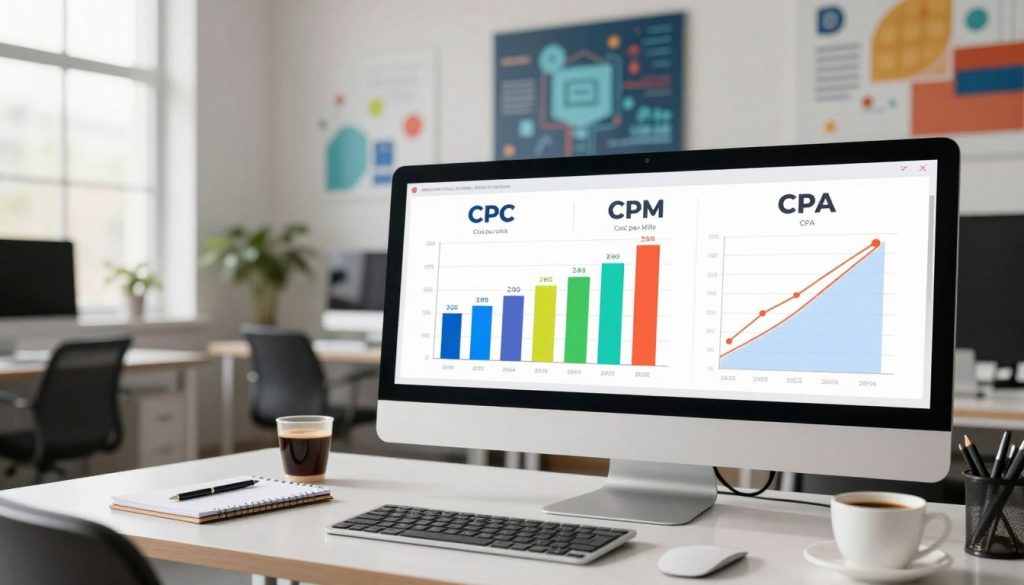
Defining your cost per click and CPA allows you to track the success of your bidding with precision.
Industry Benchmarks and Their Impact
How do your numbers compare? Industry averages provide a vital reality check. For instance, the average cost per lead across all sectors is approximately $27.66.
Reviewing this data shows if your current CPC is competitive. A high cost per click can signal a problem with your audience or creative material.
Monitoring these figures ensures your spending aligns with business goals. It identifies which ads deliver the best results and where you might be overspending.
Harnessing Meta’s Advantage+ AI Campaigns
The introduction of Advantage+ AI campaigns has transformed how marketers approach paid social media. These tools leverage machine learning to automate complex optimization tasks. They allow brands to achieve better results with less manual intervention.
This system handles key aspects like bidding and audience selection dynamically. Your focus can shift to creative strategy and overall business goals.
How AI Optimizes Bidding and Targeting
AI algorithms analyze performance data in real-time. They adjust bids to compete effectively in auctions. They also refine targeting parameters to reach users most likely to convert.
Meta Advantage+ AI campaigns can provide up to a 32% boost in ROAS for businesses. The technology tests up to 150 creative variations to find the most effective combination.
Real-World Examples of Improved ROAS
One e-commerce brand successfully cut its CPA by 25%. It also gained 15% more conversions during a peak season using these tools.
The automated system identified high-value audiences and optimal ad placements. This approach reduced time spent on manual adjustments.
Consistent monitoring ensures alignment with specific brand objectives. However, the AI handles the heavy lifting of daily optimization for your ads.
Leveraging Broad Targeting with AI Support
AI support transforms broad targeting from a risky gamble into a calculated, data-driven strategy. This method allows your promotions to reach beyond narrow, interest-based groups.

Machine learning analyzes user behavior patterns you might not see. It finds valuable segments within a wide net, helping to lower costs efficiently.
Expanding Your Reach Without Overspending
Using AI-driven broad targeting can lower CPMs by 20-30%. This happens because the system avoids overcrowded, manual segments.
You gain access to untapped audiences while maintaining relevance. The Andromeda AI system contributed to an 8% boost in ad quality for many brands.
This quality improvement makes your creative material more effective. It ensures you connect with the right people without overspending.
| Aspect | Manual Broad Targeting | AI-Supported Broad Targeting |
|---|---|---|
| CPM Efficiency | Often higher due to less precise bidding | 20-30% lower CPM on average |
| Audience Discovery | Relies on marketer’s intuition and limited data | Identifies hidden, high-intent user segments automatically |
| Ad Quality Score | Can vary widely based on manual setup | Systematically optimized, leading to consistent 8%+ improvements |
| Setup & Management | Time-intensive, requires constant adjustment | Automated, freeing up time for strategic planning |
For the best results, provide the AI with multiple creative variations. Three distinct versions allow it to test and learn what resonates across different groups.
Monitor your campaigns to see which new audiences engage most. This data helps you refine your approach and scale reach intelligently.
Understanding how to lower facebook ad expenses this way is key for modern marketing. It balances wide exploration with controlled spending.
Setting Up Auto-Bidding Rules for Better Results
Implementing automated bidding rules is a strategic move to optimize ad spend in real-time. This system makes dynamic adjustments based on live performance data.
It helps you achieve better results from your promotional efforts. For instance, Fossil Group utilized these bidding strategies in Q4 2023.
The brand saw a remarkable 51% boost in ROAS. It also achieved a 32% drop in cost per acquisition.

Best Practices for Bid Adjustments
Begin with small bidding adjustments of 5-10%. This lets you see how the system reacts before larger changes.
Checking performance every three hours is a smart practice. It maintains tight control over your campaigns.
These automated tools handle adjustments around the clock. They free up your time for strategic planning.
Managing Budget Pacing and Frequency
Proper budget pacing prevents overspending during peak auction times. It ensures a steady presence for your audience.
Frequency controls are equally vital. They stop ad fatigue from hurting your ads and wasting your budget.
According to Hootsuite’s 2024 analysis, consistent optimization led to an 18% cost reduction over six months. These rules deliver efficient results.
Testing Ad Creatives with Advanced AI Tools
Wayfair’s analysis of 500 creative variations in 30 days demonstrates the power of automated testing. Advanced AI tools for evaluating promotional material can slash your cost per acquisition by 22%. They identify the most effective visual and text combinations with incredible speed.

These systems assess your copy, images, and videos about 83% faster than manual methods. This allows for rapid iteration of your campaigns. Maintaining 95% brand consistency is a key benefit, as seen with tools like Smartly.io.
How to A/B Test Creative Elements
Start by isolating one variable at a time. Test different headlines against the same image, or swap primary visuals while keeping text identical.
Use AI to run these comparisons simultaneously across your audience segments. This systematic testing is critical for improving your click-through rate. It ensures you always use the most engaging content.
Follow a simple process for best results:
- Define a clear goal, like lowering cost per click or boosting roas.
- Launch a few strong variations, not dozens of weak ones.
- Let the AI gather significant data before drawing conclusions.
Measuring the Impact on Cost Per Acquisition
Clear data shows which creative elements drive conversions. Link your testing results directly to your conversion tracking. Watch how changes in creative affect your overall acquisition costs.
A successful test will show a measurable drop in CPA alongside stable or improved conversion volume. This proves your new ads are more efficient. Always balance automation with human oversight to respect brand guidelines.
This focused approach turns creative optimization into a reliable engine for better ads performance and smarter spending.
Monitoring Meta’s Opportunity Scores for Optimization
Meta’s Opportunity Scores offer a powerful lens for fine-tuning your promotional efforts. This diagnostic tool within Ads Manager provides real-time insights into campaign efficiency. Regular monitoring of these scores can lead to a 5% drop in your overall advertising costs.
These metrics help pinpoint inefficiencies in your targeting and bidding strategies. They allow for quick, data-driven optimizations of your active campaigns.
Interpreting Opportunity Score Metrics
The AI evaluates four main factors: audience relevance, creative performance, bid competitiveness, and budget pacing. It synthesizes this data into a single, actionable score.
Focus your attention on ad sets with scores below 50. These areas represent the greatest potential for performance gains and smarter budget allocation.
| Opportunity Score Range | Interpretation | Recommended Action |
|---|---|---|
| Below 50 | High inefficiency detected | Prioritize immediate review and adjustment |
| 50 – 70 | Moderate performance | Monitor closely and test incremental changes |
| Above 70 | Good efficiency | Maintain current strategy; consider scaling |
By applying these recommendations, you ensure your budget fuels the most promising audience segments. Review score changes weekly to measure the impact of your optimizations.
This proactive approach helps you stay ahead and maintain high-quality results. It transforms raw data into a clear roadmap for reducing costs and improving your ads.
Incorporating Third-Party Tools Like AdAmigo.ai
Supplementing Meta’s built-in advertising suite with external tools can unlock significant performance gains and cost savings. These specialized platforms add sophisticated layers of automation and insight.
Enhancing Meta’s Native Capabilities
Tools like AdAmigo.ai work alongside your existing setup. They provide continuous monitoring and predictive modeling for your ads.
This extra optimization can reduce your CPA by a notable 27%. The platform operates around the clock, making real-time tweaks.
These adjustments help keep your costs low and your performance high. For businesses with monthly promotional budgets under $5,000, plans start at an accessible $98.
Integration is straightforward. The tool connects to your meta campaigns to maximize the value of your advertising data.
It does not replace native features. Instead, it strengthens them for a more robust marketing framework.
Consistent use ensures your ads remain optimized, even when you are not actively managing them. This leads to more efficient spending and better overall results.
Utilizing AI for Enhanced Audience Targeting
Predictive analytics powered by artificial intelligence is revolutionizing how marketers identify and engage potential customers. This advanced approach moves beyond static demographics to analyze dynamic user behavior.
It focuses on finding individuals most likely to take meaningful action. This precision directly improves your promotional efficiency.
Identifying High-Value Prospects with Predictive Analytics
Machine learning algorithms examine cross-platform activity patterns. They process vast amounts of data from your CRM and website analytics.
This integration helps pinpoint users with the highest intent to convert. The system can then automatically exclude those unlikely to engage.
Such real-time audience refinement saves money on wasted impressions. One retailer integrated offline sales data into their model.
They achieved a 31% lower CPA and a 24% higher ROAS. These performance gains are typical for brands using these techniques.
Overall, AI-driven targeting can reduce your cost per acquisition by 30%. It also delivers a 45% boost in click-through rate.
Your return on ad spend may rise by 20-35%. This ensures your campaigns reach the right people at the optimal moment.
Understanding these insights is crucial for scaling reach competitively. It makes your ads more relevant and your spending more effective. Continuously optimize your ads with this targeting approach for sustained success.
Bidding Strategies and Budget Management Tips
The choice between manual control and automated systems defines your campaign’s efficiency. Your approach to spending directly impacts your promotional outcomes and resource allocation.
Comparing Manual vs. Automated Bidding
Selecting the right method is crucial for your goals. Manual bidding offers granular control for experts who understand auction dynamics.
Automated bidding is often better for maximizing a fixed budget. The platform’s algorithms adjust in real-time to find value.
| Aspect | Manual Bidding | Automated Bidding |
|---|---|---|
| Control Level | High – you set exact maximum bids | Moderate – the system decides within goals |
| Time Investment | Significant – requires constant monitoring | Low – frees up your time for strategy |
| Budget Efficiency | Can be high with expert knowledge | Consistently high for most campaigns |
| Best For | Specific, short-term promotions with strict margins | Ongoing campaigns focused on overall performance |
Proper budget management starts with choosing the right type. Facebook offers lifetime budgets for scheduled ads and daily budgets for ongoing campaigns.
Setting bid caps prevents overspending. This requires knowing your conversion rates and profit margins well.
Regularly audit your bidding settings. This keeps your strategy aligned with seasonal demand shifts.
Pace your spending to avoid cost spikes. A steady presence throughout the day often yields better results.
Mastering these techniques maintains a consistent presence. It also keeps your total expenditure firmly under control.
Data Insights and Performance Analysis for Facebook Ads
Visual dashboards transform complex performance data into clear, actionable intelligence. This analysis is essential for understanding why your promotional results fluctuate.
It reveals the direct link between your strategic choices and their financial outcomes. Consistent review of this information is your best defense against rising expenses.
Key Metrics to Monitor for Cost Reduction
Focus on a core set of indicators to guide your optimizations. The median cost per thousand impressions (CPM) for Facebook Ads is $7.20, according to Databox benchmark groups.
Compare your numbers against this median to gauge efficiency. Track these vital metrics closely:
- Click-Through Rate (CTR): Measures how often users engage with your creative material.
- Cost-Per-Click (CPC): The average amount spent for each engagement.
- Return on Ad Spend (ROAS): Shows the revenue generated for every dollar spent.
- Ad Frequency: Indicates how often the same user sees your promotion.
High frequency often leads to audience fatigue and wasted budget. Combining CPC and ROAS gives a complete picture of your campaign’s contribution.
Use dashboards to visualize spend across individual campaigns. This helps you reallocate funds to your highest-performing ads quickly.
We recommend tools that automate this visualization. They save time and enable faster, more informed decisions to protect your budget.
Spotting inefficiencies early allows for corrective action before they impact your bottom line.
Cut Facebook Ad Costs in Half This Year: 7 Proven Strategies
The most successful brands don’t rely on a single tactic. They build a synergistic system of automated optimizations.
Our seven proven methods are designed to work together seamlessly. This integration is the key to unlocking maximum efficiency.
Integrating Multiple AI-Driven Techniques
Begin with Meta’s Advantage+ campaigns for foundational AI optimization. Then, layer in automated bidding rules and predictive audience targeting.
Continuously feed this system with data from rigorous creative testing. This integrated workflow creates a compounding effect on your overall campaign performance.
Each strategy supports the others. This creates a streamlined process that maximizes your return on every dollar spent.
Real-World Case Studies and Success Stories
Data shows Advantage+ campaigns alone can drive a 57% higher ROAS. Brands that combine these techniques see even greater gains.
They overcome rising expenses by letting each AI-driven component handle a specific task. The result is more effective ads and smarter budget allocation.
Implementing this requires commitment to continuous testing. The payoff is reaching more of the right people while keeping your annual spending firmly in check.
Conclusion
Your journey toward more efficient marketing begins with the actionable steps outlined in this resource. This guide has equipped you with essential tools for managing your ads effectively in the current landscape.
By applying these AI-driven methods, you can enhance campaign performance and ensure your budget reaches its full potential. The best way to succeed is through continuous testing and metric monitoring.
Adapt your approach based on data insights. We hope these tips help you navigate the complexities of the advertising platform and achieve your business goals.
Start implementing one or two strategies today. Watch them transform your overall marketing results and improve your ads’ efficiency.
Thank you for following this comprehensive resource to reducing expenses and maximizing your return on investment.