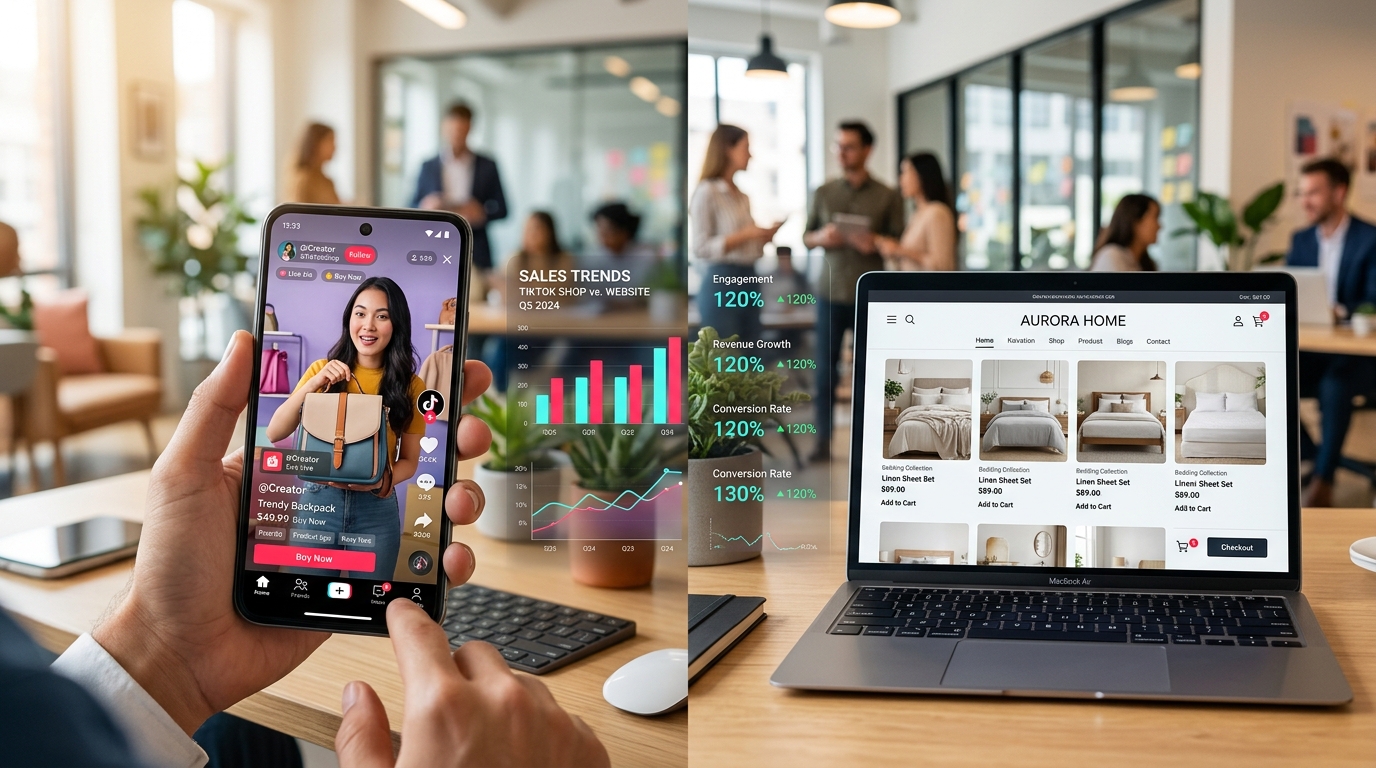
Choosing where to sell is more than a channel decision. TikTok Shop can help a product reach new shoppers, while an independent website gives a brand more control over customer relationships, the buying experience, and long-term value.
The platform launched its U.S. marketplace in 2023 and is described as established in the United States by 2026. Its reach can draw attention, but that traffic is rented. An email audience, by contrast, can support repeat visits over time.
This guide compares sales potential, customer data, traffic, fees, and control in today’s U.S. market. It uses a $50 average order value to frame fees across several monthly revenue levels, without treating either channel as the answer for every business.
Use TikTok Shop when discovery and creator-led content fit your marketing plan. Consider an owned site when direct customer access and a distinct brand experience matter most. For many brands, the right starting point depends on the product, available time, and resources.
Key Takeaways
- Social discovery can bring new shoppers to a product.
- An owned site offers more control over customer relationships.
- The U.S. marketplace launched in 2023 and is described as established by 2026.
- The fee model uses a $50 average order value across monthly revenue levels.
- Compare traffic, costs, customer data, and control before choosing a channel.
- A combined approach may suit brands with the time and resources to manage both.
TikTok Shop vs. Website Sales: Which Works Better?
These channels create different paths from discovery to purchase. One can put a product in front of new buyers; the other gives a business more control over the buying journey.
Product Discovery and In-App Checkout
TikTok Shop is a social commerce feature launched in the U.S. in 2023. A user can watch a video, open an in-app product page, and pay without leaving the platform.
Its recommendation system may introduce new products to people who have not searched for them. After approval, sellers may be ready to sell within days, according to the source.
Direct Sales Through an Independent Website
An independent website gives brands control over design, messaging, checkout, and the direct customer relationship. It offers a distinct experience, but it does not bring traffic on its own.
For 2026 campaigns, reported average conversion rates were 3.2% for TikTok Shop and 1.4% for website campaigns. Treat these figures as benchmarks, not promises; results can vary with demand and audience.
For a useful comparison, consider:
- Where buyers are most likely to discover the product.
- What customers need before they feel ready to order.
- Which platform features and data access fit the business.
Setup Time and Launch Requirements
Launch speed depends on how much control and customization your business needs. A fast start can help you test demand, while a fuller build takes more planning.

Getting a TikTok Shop Ready to Sell
After approval, a TikTok Shop can be live in one to five days. First, prepare clear product details, fulfillment plans, and your seller account. This short setup can help you test a new offer, but it does not ensure sales.
Building and Testing an Ecommerce Store
A complete website often takes four to twelve weeks. That timeline can cover design, product listings, payment tools, delivery choices, and testing the buying experience. The source estimates that a professional build may take 7–14 business days.
For a hands-on route, select Shopify or another platform, add products, set up checkout, then test each step. Shopify can simplify setup, though initial costs and your available time still matter. A clear guide can help you plan the work.
Choose the launch pace that fits your goals: start quickly to test demand, or invest more time in a direct channel built for long-term growth.
Fees, Operating Costs, and the Break-Even Point
Platform fees can affect a product’s margin, even when order volume holds steady. These figures offer a model, not a guarantee. Actual costs may vary by plan, payment method, and contract.
Comparing Commissions and Payment Processing
The model assigns TikTok Shop a 6% commission plus 2.9% processing. Shopify Basic has a $39 monthly fee, 2.9% processing, and a $0.30 charge per transaction. Include fulfillment and other business expenses in your comparison.
How Revenue Affects the Cost Advantage
With a $50 average order value, the estimated break-even point for an independent website falls near $800–$1,000 in monthly revenue. Above that range, the model favors the owned store on fees. Conversion rates and customer acquisition costs can still change the outcome.
At $10,000 in monthly revenue, the estimate uses Shopify Grow at $79 per month and shows $5,532 in annual savings. Check current platform terms and your own data before changing plans.
Compare recurring charges, processing fees, and commissions together to see their impact on margins and long-term growth.
| Monthly revenue | Independent store plan | Estimated annual savings |
|---|---|---|
| $2,000 | Shopify Basic | $828 |
| $5,000 | Shopify Basic | $2,772 |
| $10,000 | Shopify Grow | $5,532 |
Traffic, Reach, and Product Discovery
New buyers may find a brand through a social feed or a search result. TikTok Shop offers algorithmic discovery, but reach can shift with user interests and platform choices. Treat it as an opportunity, not a promise.
Algorithmic Discovery and Creator-Led Reach
Recommendations can put a product in front of people who have not heard of the business. Creator videos, affiliate posts, and campaigns may also spark interest. Still, one video may draw a crowd while another gets little attention. A sound strategy spreads effort across several channels.

Building Visits Beyond the Feed
An independent website has no built-in audience. Brands must build traffic with SEO, email, ads, and social content over time. TikTok Shop can support that mix, while owned channels help steady growth beyond a single platform.
A 2026 benchmark puts website-campaign attribution accuracy at 60–75%. The source estimates that 25–40% of conversions may go untracked, so reports may miss some buyer activity.
- Use varied channels to reach new buyers and support long-term growth.
- Review campaign data with care; attribution does not show every path to a purchase.
Conversion Rates, Order Values, and the Shopping Experience
Convenience can lift completed orders, but it does not tell the whole story. Average basket size and ad costs also shape returns. These 2026 campaign figures offer a starting point, not a promise for every business.
Frictionless In-App Purchases and Impulse Buying
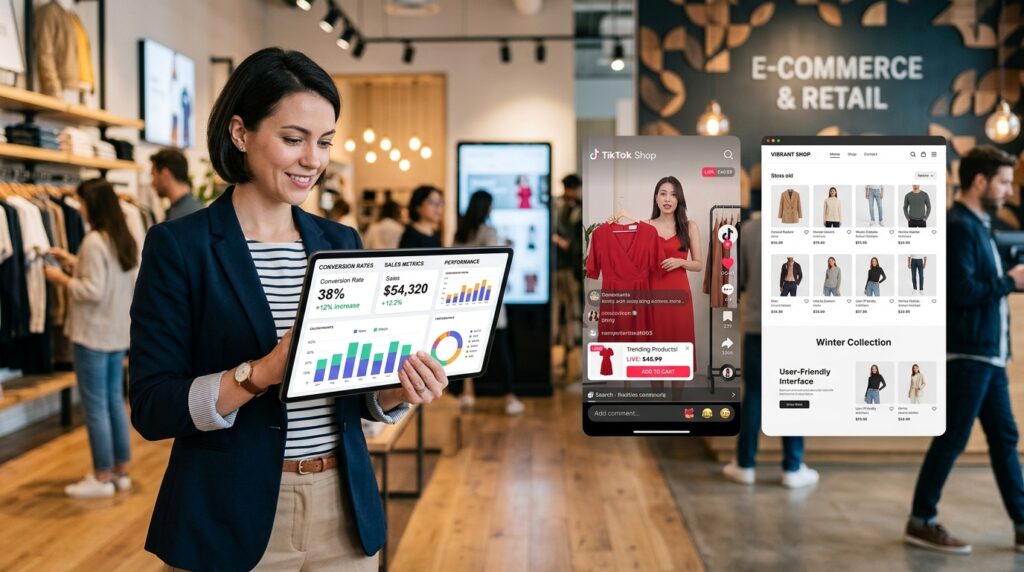
TikTok Shop lets buyers move from a creator’s video to checkout with few steps. That short path may suit a low-cost product that sparks quick interest. Reported conversion reached 3.2%, with an $18 cost per acquisition and 4.8x average ROAS.
Website Advantages for Higher-Consideration Products
A website can give shoppers room to review details, compare options, and find reassurance. Its reported conversion rate was 1.4%, but the average order value reached $68, compared with $42 in the app. Bundles and add-ons may raise order totals. Acquisition cost was $32, and average ROAS was 3.2x.
Test by product and audience. Track campaign data and repeat purchases, since these benchmarks do not show every lifetime-value gain. A considered experience may support higher-value products, while quick checkout may help other offers.
| Campaign type | Conversion rate | Average order value | Cost per acquisition |
|---|---|---|---|
| In-app checkout | 3.2% | $42 | $18 |
| Website campaign | 1.4% | $68 | $32 |
Customer Data, Email Marketing, and Brand Control
A sales channel can show order patterns, but access to buyer details shapes what a brand can do next. Direct contact can support customer loyalty and repeat purchases.
What Sellers Can Learn From TikTok Shop Orders
TikTok Shop sellers can review order volume, but its terms bar them from collecting buyer email addresses or contact details. This limits direct customer follow-up and keeps customer data within the platform.
At 200 orders a month for 24 months, a business could reach about 4,800 buyers. An owned list gives the brand more control over customer data and future outreach.

Building Direct Customer Relationships on Your Website
An independent website can collect an email at checkout. With permission, send abandoned-cart notes, post-purchase follow-ups, and product announcements. These touchpoints give customers a direct path to the brand.
Email marketing can support repeat revenue, though results vary. The cited industry average is $1–$3 in monthly revenue per subscriber, not a promise. Use the estimate as a planning guide, then track results.
- Keep customer data organized and use it with care.
- Use email to share useful updates and encourage repeat orders.
Owned contact details offer more control over long-term customer relationships.
Marketing Tools, Creators, and Campaign Strategy
A strong marketing strategy matches each campaign to the way customers like to discover and buy. Short-form content can spark interest, while follow-up tools can help bring visitors back.
Using Video, Live Selling, and Affiliates
With TikTok Shop, brands can pair video content with live selling and creator partnerships. Creators can feature products through shoppable affiliate links, leading viewers to native checkout. This gives each campaign a clear path from discovery to purchase.
Active live selling takes multiple hours per week at minimum. Plan around staff time, inventory, and content needs before adding it to your strategy. The in-app tools can support a business, but consistent activity takes effort.
Retargeting Visitors and Following Up
Website campaigns can use ads to reach visitors who leave without buying. Email marketing can also share useful reminders and product news. These tools support follow-up beyond the first visit.
Paid campaigns may rely on the TikTok Pixel, but its tracking has limits. iOS App Tracking Transparency, browser rules, and ad blockers can affect measurement. Compare platform reports with your own order data, and treat results as estimates. Shopify integrations may help coordinate campaign activity, but no single tool captures every customer action.
Which Channel Fits Your Products and Price Points?
Price can help narrow the choice, but buyer needs matter too. Consider how easily people can judge an item online and what details they need before they order.
Products That Benefit From TikTok Shop Discovery
Visual, simple-to-demo items can gain from creator videos and quick discovery. The source suggests starting with items under $50 on TikTok Shop. For the $50–$100 range, test both destinations and compare demand, conversion, and revenue.
- Good discovery fit: products shoppers can understand through a short video.
- Test both: mid-priced offers with room for different buyer paths.
Products Better Suited to a Website
Items priced at $100–$200 may need richer detail to build customer confidence. A website can show specifications, sizing, ingredients, and care guidance. For products above $200, the source strongly favors an owned site, where buyers can take time to review options.
In 2026, TikTok Shop is described as fully available in the United States and United Kingdom; access varies elsewhere. Test each product across channels, then use demand and buyer feedback to refine your strategy.
Platform Dependence and U.S. Regulatory Risk
As of 2026, the U.S. regulatory outlook for TikTok Shop remains unresolved. Divestiture or a ban are among the possible outcomes under discussion. The service is described as fully available in the United States and United Kingdom, but current access does not remove future policy risk.
Relying on one platform for sales, customer access, and daily operations can expose a business if rules or availability change. Revenue may also shift quickly when a single channel drives most orders.
There is a practical limit, too. TikTok Shop reviews, order history, and seller metrics cannot be exported to another platform. That makes it hard to move an account’s history, while customer data and brand relationships may remain concentrated in one place.
- Keep records you can lawfully manage outside the platform.
- Consider a second channel to support growth and reduce reliance on one source.
Separate regulatory risk from routine operating risk. The channel can still be useful, but a balanced plan gives you more control. Use this guide to weigh its reach against the value of a more resilient sales mix.
When TikTok Shop Is the Better Starting Point
A new product does not always need a full online store on day one. For brands still testing demand, this channel can offer a practical way to learn what customers respond to.
It can suit a business that has not built steady website traffic yet. After approval, setup may take one to five days, according to the source. That short launch time can help sellers gather early feedback and make timely changes.
- Trend-driven products may gain from fast discovery and timely content.
- Sellers with strong live-selling skills can use real-time product demos.
- Markets where this platform is well established may offer a clearer path to reach buyers.
The source suggests that sellers earning under $1,000 in monthly revenue, while still testing product-market fit, may keep this as their primary channel. That can be a useful starting strategy for early sales.
Starting here can be a short-term choice, not a lasting commitment. Use the results to guide future growth, then consider adding other channels as revenue and customer insight improve.
When to Build Your Own Website
Steady orders can show when a direct channel is worth the added effort. Look for repeat demand, not just one strong month, before taking on new tasks and costs.
Revenue and Repeat-Customer Signals
One signal is monthly revenue of $2,000 or more from TikTok Shop. A separate source points to about £5,000 per month, plus returning customers, as a reason to invest. That figure is in pounds, not dollars.
- Returning buyers and products with lasting demand can support a direct channel.
- An email list helps you reach customers and collect customer data with permission.
- A website gives your brand more control over the buying experience.
Compare Shopify Basic at $39 per month with one-time store builds listed at $699 or $999. A professional setup may take 7–14 business days, so plan for that time as well as ongoing costs. Shopify tools can help, but you still need a plan to bring in traffic.
Take this step when the business can manage its own traffic and customer relationships. A direct channel can support growth when products have repeat appeal and the team is ready to handle daily operations. Use this guide to weigh the investment against current results.
How to Use TikTok Shop and Your Website Together
One channel can introduce a product, while another helps a brand build lasting customer ties. For many sellers earning over $2,000 per month, a dual-channel strategy can balance discovery with repeat orders.
Assigning Each Channel a Role in the Customer Journey
Use TikTok Shop for discovery and first purchases. Video content, creators, and affiliate campaigns can put products in front of new buyers. From there, shoppers can check out in-app or visit the website for more details.
An owned store gives you more control over the buying experience. It can also collect email sign-ups with permission, so you can share useful offers and bring customers back. Keep social commerce as a way to reach new audiences.
Testing Performance and Shifting Your Sales Mix
Compare campaigns by product and audience, then review conversion, customer value, traffic quality, and operating costs. Reported attribution accuracy is 95% or higher for TikTok Shop campaigns, compared with 60–75% for website campaigns. Pixel, browser, and privacy limits may leave 25–40% of website conversions untracked, so use more than one data source.
- Test ads and creator content across channels.
- Shift budget toward the path that brings valuable customers at a sustainable cost.
Conclusion
Growth rarely follows one fixed route; let buyer behavior and margins guide your next move. TikTok Shop can create quick discovery and in-app checkout. The shop can put a new product before shoppers. 2026 benchmarks report a 3.2% conversion rate, compared with 1.4% for website campaigns.
An owned site offers email access and brand control. Under the cited fee model, its cost edge begins near $800–$1,000 in monthly revenue. Consider product price, buying effort, traffic needs, repeat potential, and product fit before choosing a channel.
Use content to introduce a product and build direct customer ties through your own store. Test both channels, track costs, and adjust the sales mix as demand shifts. Results can show where products gain traction and help U.S. sellers grow a more resilient business asset.