
A video can rack up views without orders, which is the problem How to Build a TikTok Sales Funnel That Converts is meant to solve. A high view count shows that people saw your content, but it does not show that they know your brand, understand what you sell, or can find a clear way to buy.
TikTok can help your business earn discovery, build trust, and support buying decisions. The work is connecting attention to a useful next action, not chasing views alone. You can do that by linking organic content, creators, paid media, and commerce in a practical marketing process, without assuming any one post will deliver guaranteed sales.
This approach gives users a path from first contact to purchase and a reason to return. It also gives you a way to see where people lose interest, so you can adjust your content and marketing instead of simply increasing media spend. Start by understanding the full-funnel approach and the role it plays in connecting attention with revenue.
Key Takeaways
- Views and followers are not the same as customers or sales.
- Give each audience a clear next action, from learning to buying.
- Connect organic content, creator posts, paid media, and commerce.
- Use customer behavior to shape your messages and audience groups.
- Measure TikTok alongside your wider business results.
How to Build a TikTok Sales Funnel That Converts
A TikTok sales funnel moves potential customers from discovery toward purchase and repeat buying. Full-funnel marketing is a coordinated approach that uses content, creators, paid media, and commerce to serve customers from discovery through purchase and repeat buying.
Treat TikTok as a place to support the customer journey, not only as an awareness channel. Someone may discover a brand in a For You page video, watch creator content, research the product, and buy soon after. Another person may see the video, leave, and return later through a different touchpoint.
The path can move in more than one direction. A customer might ask questions before watching a demonstration, or buy after seeing a creator use the product without visiting the brand’s profile. Your marketing should make each useful next step easy to find.
TikTok reports that 68% of people agree its For You page feels unique because it can surface products they did not previously know. TikTok users are also 20% more likely to focus solely on TikTok while using it than users on other platforms.
Those figures describe platform behavior, not a promise that every brand will make a sale. They do show why TikTok can create discovery and hold attention, giving a brand room to support research and buying as well.
A sales funnel gives that activity a structure. Its distinct stages have different jobs, from introducing the brand to encouraging another order, so it helps to map them before choosing campaign tactics.
What Are the Five Stages of a TikTok Sales Funnel?
The five stages are awareness, engagement, consideration, conversion, and loyalty. Each stage has a distinct job: introduce your brand, build interaction, help an audience assess fit, make buying possible, and encourage customers to return.
Use the stages as connected goals, not as a rigid sequence every customer must follow. The table shows the main purpose of each stage and a simple next step for your content or sales process.
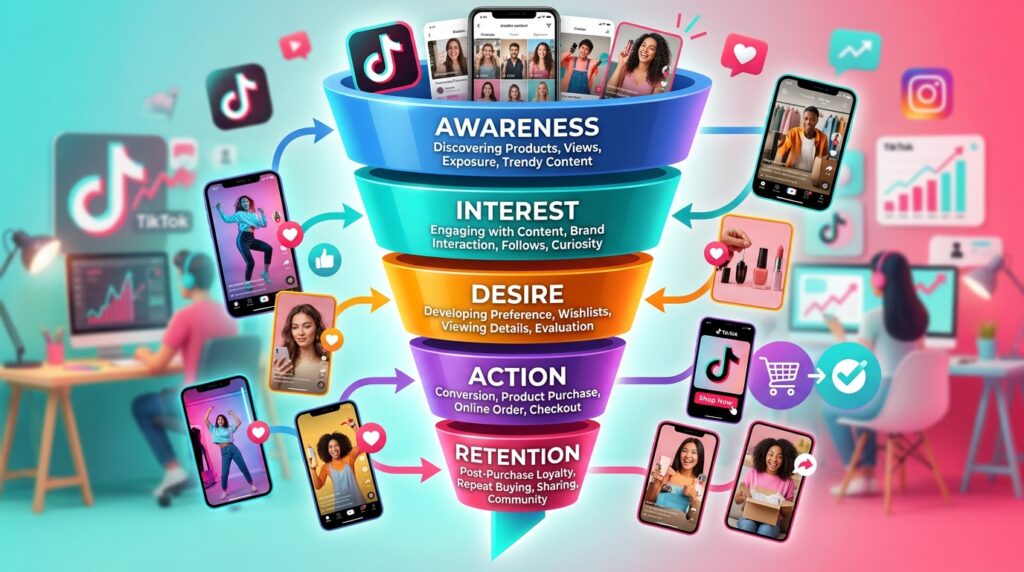
| Stage | Main goal | Example content or touchpoint | Next step |
|---|---|---|---|
| Awareness | Introduce the brand through broad-reach videos | Quick product problem-and-solution video | Invite an interaction |
| Engagement | Turn viewers into active community members | Comment prompt or profile follow | Offer deeper product learning |
| Consideration | Build trust and explain product relevance | Demo or customer story | Support a buying decision |
| Conversion | Make purchasing easy | Clear offer and checkout path | Begin post-purchase care |
| Loyalty | Encourage repeat purchases and advocacy | Customer-focused content and relevant follow-up | Feed advocacy into discovery |
Consideration is the middle of the funnel. People there may recognize your brand and want more detail, but still need to understand whether the product fits their needs. A useful customer story can help them see the product in a real context.
Customers may skip a stage, repeat one, or move between stages. A returning buyer could purchase again after a reminder, while a new audience member could go from a creator video straight to checkout.
The map helps you distinguish those audiences and choose a relevant next action. Your goals, campaign setup, and audience groups give that map a practical starting point.
How Should You Set Up Goals and Audience Groups?
Running only conversion campaigns can exhaust the same pool of high-intent users. Set goals and audience groups around different customer behaviors, so your marketing can reach new people as well as those already close to buying.
Give each audience a specific next action and leave budget to bring new audiences into the funnel. TikTok suggests allocating roughly 15-20% of budget to upper- or mid-funnel activity. Treat that as a starting suggestion, not a universal allocation.
Build your strategy with this five-part checklist:
- Set a business outcome and record its baseline, such as orders or revenue.
- Choose a stage-specific campaign goal that supports that outcome.
- Create audience groups from actual behavior, not broad assumptions.
- Reserve budget to reach people who have not engaged with your brand.
- Give every group a clear next action, such as watching, learning, or buying.
Behavior-based audiences can help you distinguish intent. Practical examples include engaged users in the last 60 days, viewers who watched at least 75% of a video in the last 30 days, and profile visitors in the last 30 days.
You might also group website visitors and TikTok Shop product viewers from the last 14 days, then add-to-cart or checkout users from the last 7 days. Adapt these windows to your sales cycle and available audience volume.
A sound setup still needs different messages for people at different stages. Start with content that introduces your brand to people who have not encountered it before.
How Do You Build Awareness on TikTok?
An entertaining video earns attention; an effective awareness video also makes its brand and purpose clear. Make recognition part of the creative, so new people can connect what they saw with your business and what it offers.
Attention matters only when viewers can identify the brand and understand the offer. Keep the message easy to process, especially when a viewer has never seen your product or heard your name.

Use native organic content to earn discovery
Use broad-appeal storytelling to introduce a product through a familiar problem, a quick tip, or a simple before-and-after. Relevant trends, sounds, and duets can help your content feel at home in the feed, but a trend should fit your brand and audience.
A popular sound is not a strategy by itself. If it distracts from the product or conflicts with your brand voice, it may draw views without helping people remember what your business does.
Make the first seconds easy to follow. A concise problem-and-solution video can show what a customer struggles with, then make the product’s role clear without turning the story into a long sales pitch.
Use broad paid reach and clear brand messaging
Use broad prospecting to reach new audiences rather than filtering so narrowly that your campaign has little room to find people. Pair that reach with strong opening hooks, visible brand identity, and a clear description of the offer.
Short, easy-to-process messaging helps viewers understand the value before they scroll. Show the product or brand early, then explain one useful point instead of packing several claims into a few seconds.
When people recognize the business and understand what it offers, discovery can lead to a response. Give viewers a reason to interact, then build the relationship through engagement.
How Can You Turn Viewers Into an Engaged Community?
A curious viewer may comment on a product but still need a reason to keep interacting. Respond with useful, human answers that make the next exchange feel worthwhile, rather than treating every comment as a sales lead.
Interaction grows when your content invites a specific response and your brand follows through. TikTok users say the platform helps them get ideas about brands and products they had not considered: 80% report this. That context supports the value of discovery, not a guarantee of engagement or sales.
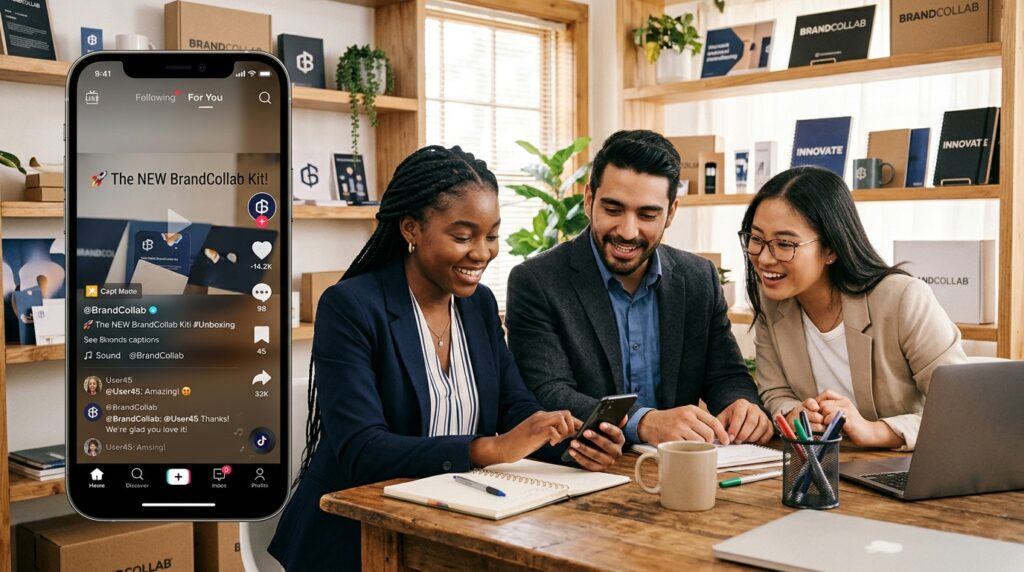
Build community into your regular content routine:
- Reply to product questions in comments with a useful, direct answer.
- Invite specific responses, such as which feature viewers want explained.
- Answer common questions with video replies that others can also use.
- Use a human tone that sounds like a helpful person, not a script.
Make interaction part of the content routine
Choose prompts people can answer without much effort. Ask what they would use a product for, or which of two options they want to see next. Then respond in a way that adds information, not just another request for attention.
Comments can also reveal what needs clearer explanation. If several people ask the same question, answer it in a video and make that answer easy for future viewers to find.
Amplify proven organic posts with Spark Ads
Spark Ads are TikTok’s in-feed paid amplification of organic posts. A Spark Ad promotes an existing post while keeping its engagement and social proof attached to that post, rather than starting a separate ad with no visible interaction.
Choose posts with meaningful comments, shares, or saves instead of promoting every post. TikTok reports that 78% of its users have purchased a product after seeing it featured in creator content, but engagement does not ensure that any particular viewer will buy.
Sustained interaction gives you more chances to explain why the product matters. Use those conversations to guide useful product information for people in consideration.
How Do You Build Trust and Consideration?
A viewer may recognize your product but still need to see how it solves a relevant problem. Useful proof and clear explanations help people judge whether the product fits their needs before they make a decision.
Show how the product works and connect each claim to a customer concern. The middle of the funnel is consideration, where a potential customer looks for reasons to trust the brand and understand its value.
Explain product benefits with demos and answers
Demonstrate the product in the setting where a customer would use it. A founder can explain why a feature exists, while a short demo can show what that feature changes in practice.
Use recurring questions to guide content. If customers often ask about setup, care, fit, or compatibility, answer the question directly. Address objections with specific information rather than vague claims about quality.
Use creators and customer proof with a clear message
UGC, testimonials, and creator partnerships can show product use in an authentic context. A customer story can make a benefit easier to picture, while a creator can explain how the product fits into an established routine.
Choose creators for audience fit, product fit, message, engagement quality, and conversion fit, not follower count alone. A smaller creator whose audience matches your buyers may offer more useful learning than a larger account with a broad, unrelated audience.
Creator volume without positioning or a repeatable message can produce scattered content. Set a clear point for creators to communicate, then give them room to express it in a way their audience understands.
When a viewer sees clear product relevance and gains confidence, that person is better prepared to act. Make the move from interest to conversion simple and consistent with the message.
How Do You Make TikTok Purchases Easier?
A high-intent shopper can still leave when a checkout feels confusing or mismatched with the ad. Remove friction at the point of purchase by choosing a clear path and matching the buying experience to the promise that brought the customer there.
Use the checkout your business can support well and your customers can complete easily. TikTok Shop supports in-platform purchasing; a website or app may make more sense when your existing e-commerce experience better serves the customer journey.
Choose a suitable TikTok Shop or website checkout path
Compare where your customers buy with what your team can manage. Use product tagging and shoppable creative where appropriate, so viewers can move from product information to a purchase path without searching for the item again.
GMV Max is an AI-powered TikTok Shop advertising solution designed to maximize gross merchandise value, or GMV, across paid, organic, and affiliate traffic. It is a commerce option within TikTok Shop, not a replacement for a clear product page or customer experience.
Match retargeting and offers to buying intent
Retarget people based on what they did. Someone who watched much of a video may need product education, while a product-page visitor or checkout starter may need a direct reminder tied to the item they considered.
Use this five-item conversion checklist before launching a campaign:
- Use a direct call to action that tells shoppers what to do.
- Address the remaining purchase objection with clear information.
- State offer terms, including any limits or conditions.
- Keep the landing page consistent with the ad’s product and promise.
- Check mobile usability and remove avoidable checkout friction.
A time-limited discount should have a genuine end date or limit. Do not create urgency with false scarcity or claims that mislead customers about availability.
A completed first order starts the relationship rather than ending it. Follow up with useful customer experiences that encourage repeat buying and advocacy.
How Do You Encourage Repeat Purchases and Advocacy?
A customer who has received an order needs a useful next interaction, not another generic sales pitch. Follow-up should match the customer’s experience, whether that means learning to use the product, replacing it, or sharing feedback.
Give customers a reason to return before asking them to promote your brand. A helpful experience can support loyalty, while a rushed advocacy request may arrive before someone has had time to use the product.
Follow up with relevant customer experiences
Send helpful product-use content that answers questions people may have after delivery. A short tip can help customers get more from a product and reduce uncertainty about setup, care, or use.
Replenishment messages can fit products customers use up, while complementary-product suggestions can help when they solve a related need. Keep each message relevant to the item bought and the customer’s likely timing.
A reliable experience gives people a practical reason to return. Clear support, easy-to-understand product information, and a product that meets expectations can matter more than another discount.
Turn satisfied customers into useful advocates
After customers have had a chance to use the product, invite reviews or UGC with permission. Explain how you might use their story, and respect a customer who does not want to participate.
Customer stories can support discovery for new audiences because they show the product in a real setting. Keep the story accurate and avoid implying that one person’s experience is the same for every buyer.
Separate a repeat-purchase message from an advocacy request. A customer may need a replacement reminder, while a different customer may be ready to share feedback or create content.
Customer feedback and repeat behavior can shape the next round of marketing decisions. Use what customers do and say to set priorities for a phased rollout.
How Can You Roll Out the Funnel in 90 Days?
A phased launch makes it easier to learn which messages and audiences are working before you expand campaigns. Build in stages, so your team can test the purchase path and review performance without launching every tactic at once.
Use the 90-day sequence as a working plan, not a promise of profitability by day 90. Shift the timing to match your sales cycle, resources, and ability to produce content and manage campaigns.
| Timeframe | Focus | Practical actions |
|---|---|---|
| Days 1-30 | Establish and test | Publish branded content, test offers and hooks, set up audience pools, and confirm the purchase path |
| Days 31-60 | Activate consideration and conversion | Launch retargeting, test landing-page improvements, and review blended performance |
| Days 61-90 | Scale and refine | Increase investment carefully in proven campaigns, refresh creative, review customer feedback, and begin customer-focused loyalty activity |
During days 1-30, establish branded content and demand capture while building audience pools. Test a small set of offers and hooks, and confirm that a person can complete a purchase from the path shown in your campaign.
From days 31-60, add consideration and conversion retargeting. Test landing-page improvements and review blended performance, not only one campaign’s reported conversions. If the page and ad make different promises, resolve that mismatch before increasing spend.
During days 61-90, scale proven campaigns carefully and refresh creative before results fade. Review customer feedback and begin loyalty activity that fits the product, such as helpful use guidance or relevant replenishment messages.
Some businesses need more time to collect enough data; others can move faster with a short sales cycle and a ready team. Each phase needs a way to assess results across TikTok and the wider business, leading to measurement.
How Do You Measure and Improve TikTok Funnel Performance?
A customer may discover a product on TikTok and buy it later on Amazon, a brand website, or in a store. Last-click reporting can miss that path, so assess campaign data alongside changes in the wider business.
Combine platform conversion metrics with blended measures and cross-channel signals. No single measure explains every customer journey, but a set of measures can help you see where performance is improving or needs a closer look.
| Measure | What it tracks | How to use it |
|---|---|---|
| Platform conversion metrics | In-platform purchases and campaign outcomes | Diagnose direct campaign performance |
| MER | Total store revenue divided by total ad spend | Assess blended efficiency |
| Branded search and sales across Amazon, DTC, or retail | Changes in other channels | Look for possible spillover |
| Geographic tests or multi-touch analysis | Differences across comparable groups or touchpoints | Assess incremental contribution when data volume allows |
Marketing efficiency ratio, or MER, is total store revenue divided by total ad spend. TikTok reports that adding a mid-funnel tactic to TikTok Shop campaigns using GMV Max has been associated with up to 42% lower CPA and 32% higher budget utilization.
For web conversion campaigns, TikTok reports that adding mid-funnel activity has been associated with approximately 18% higher blended ROAS and 31% higher budget utilization. TikTok also reports 1.7x stronger incremental ROAS from Smart+ Catalog Ads compared with manually created ads.
Those figures describe specific campaign contexts, not expected results for every business. Use this four-step diagnostic when performance changes:
- Check tracking and checkout for errors or friction.
- Compare results by stage and creative.
- Look for changes in other sales channels.
- Use controlled geographic tests when suitable.
ROAS is return on ad spend; CPA is customer acquisition cost. Compare them with MER and customer behavior, then use the evidence to choose one next test or investment.
Conclusion
A workable funnel connects customer discovery, trust, purchase, and follow-up instead of relying on one viral post or conversion ad. That connection helps your brand support customer acquisition while giving existing customers reasons to return.
Start with one product and one audience. Find the biggest gap in the path to purchase: perhaps people see the content but do not understand the offer, or they reach the page but do not complete checkout.
Choose a measure that fits the gap, such as product-page visits, completed orders, or repeat purchases. Then select the product, map its next customer action, and set the measure before launching your next test.